Walking in Croatia: The Ultimate Guide
Five walking regions, four national parks, and daily ascent that runs from 20 metres to 1,400. This is how to tell them apart.
Quick links
Croatia is the rare walking country where the sea is never far from the path. A week here can cross vineyards, a limestone canyon, an island and a national park without repeating itself.
Most guides to Croatia are written for the beach. This one is for the walker, and publishes the real daily climb on all six trips: from 20 metres to 1,400, which decides how a week feels.
What Makes Walking in Croatia Different
Three things shape a Croatian walking week, and none of them is the coastline in the photographs. They are the reason a Croatian day with modest numbers on paper can feel harder than an alpine one, and the reason the walking season runs opposite to the tourist season. Take them in order.
The mountains start at the sea, so you climb from zero. The Dinaric range rises straight off the Adriatic with no foothills and no valley road to gain height on first, which is why the Paklenica stage carries more ascent than a gentler-looking alpine week. Croatia's highest point is only 1,831 metres, and that number tells you nothing about how hard a day is. What matters is that you meet almost all of it on foot.
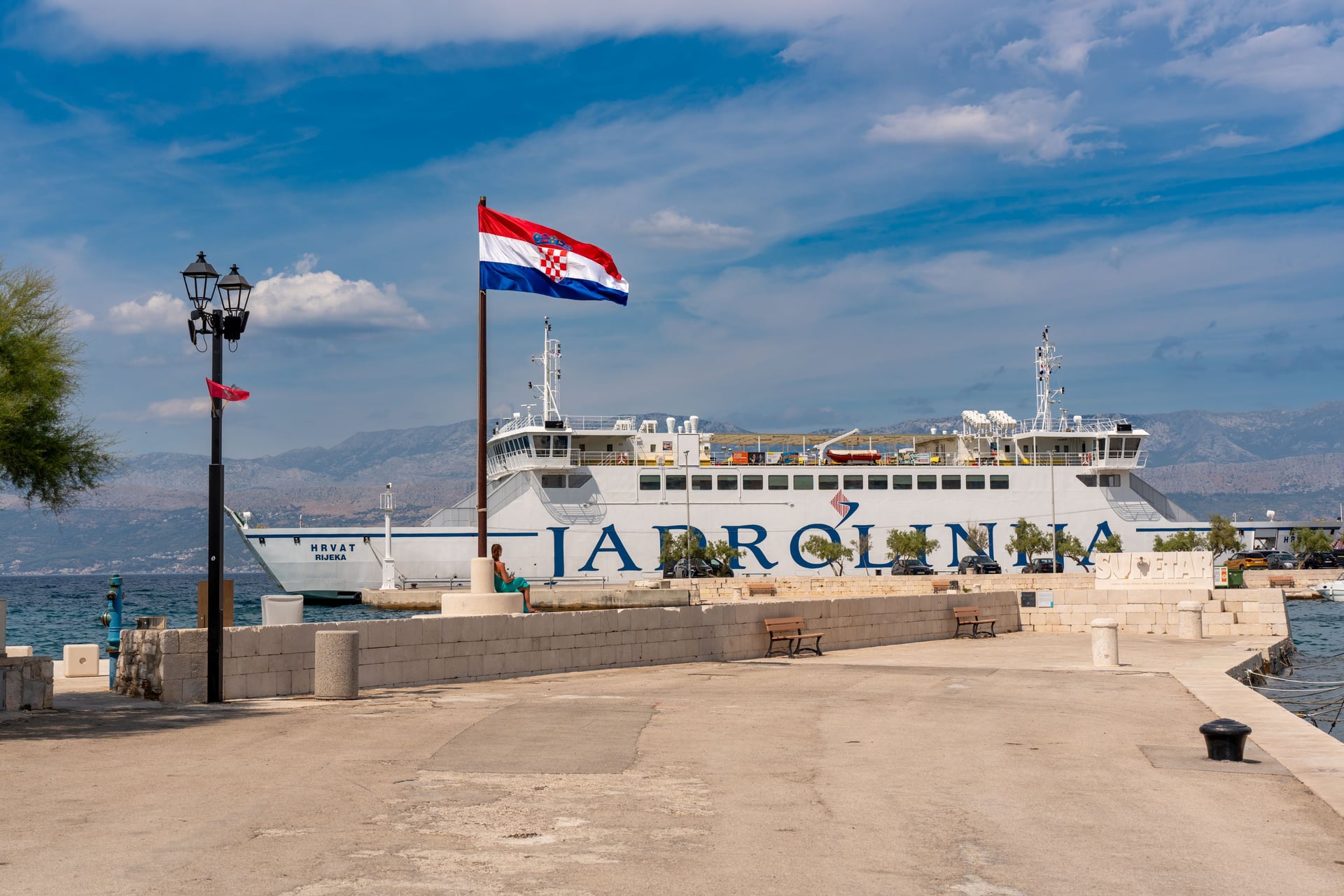
Ferries are part of the walking, not just the transport. On the islands the boat timetable, not your legs, sets the shape of the day, and a missed sailing can cost you the afternoon rather than an hour. That is a real planning constraint and also the appeal: you finish a walk and step onto a boat. It also caps the distance, because each island gives you one good crossing and no more.
The mountain infrastructure is thin. North Velebit National Park has two staffed huts in the whole of it, plus a handful of shepherds' huts and one unmanned shelter. An equivalent area of the Alps would hold dozens of refuges, so a Croatian hut route is planned around what exists rather than around how far you fancy walking. On the ridge itself there is no shop and no village between the huts, which is a supply problem before it is a walking one.
Which Walking Region to Choose
Five regions carry the walking, and they ask genuinely different things of you. Pick the region before the route.
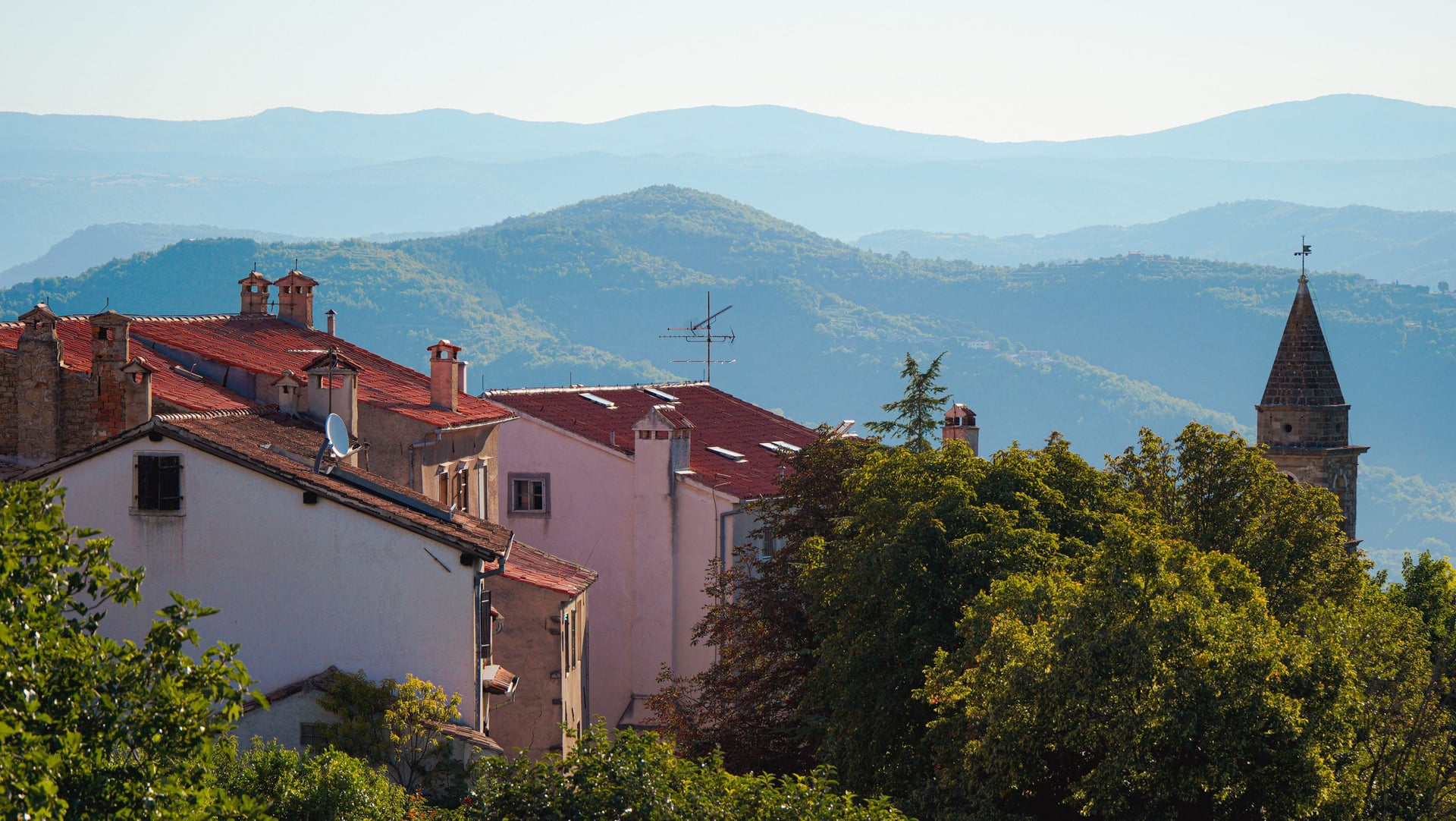
Istria
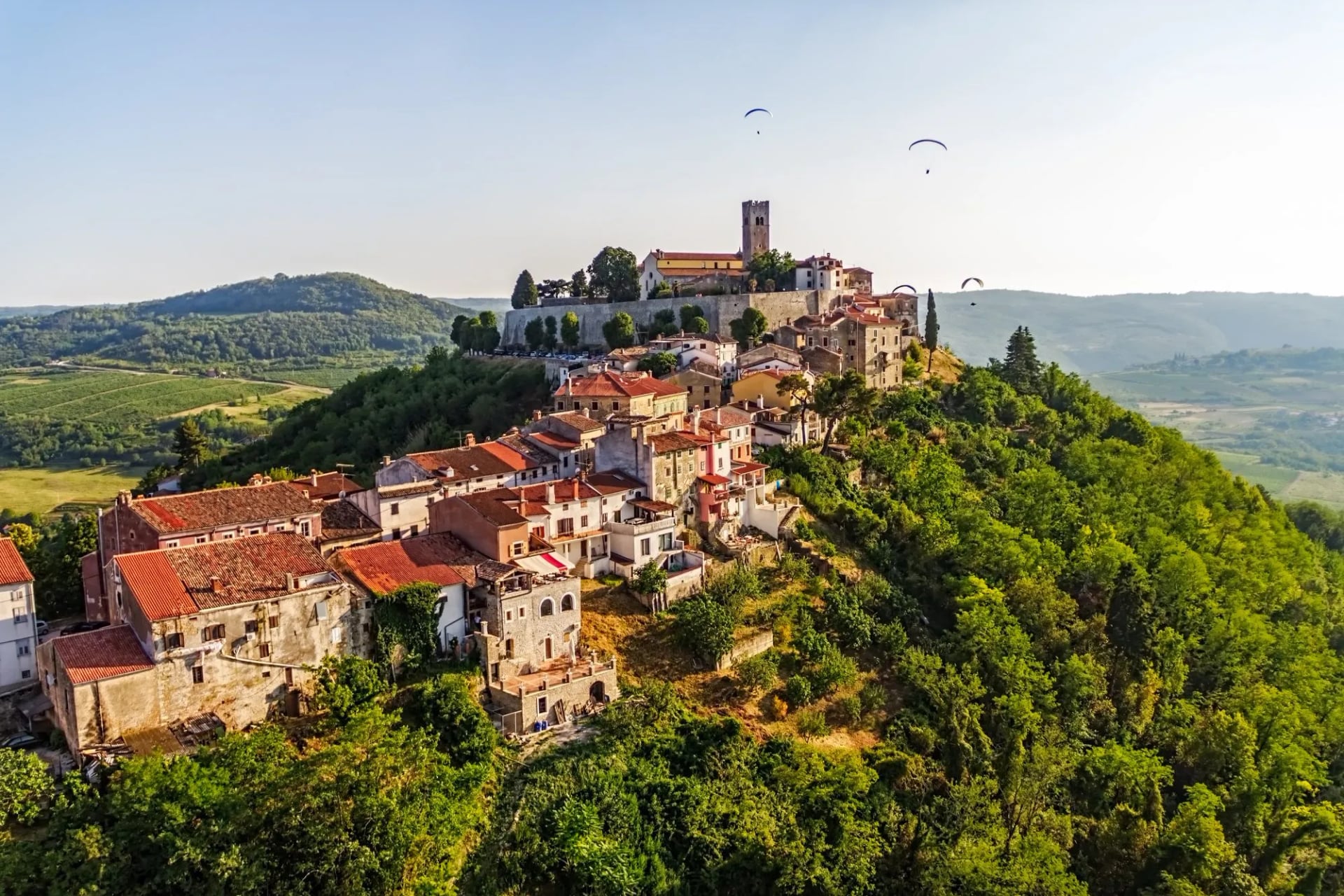
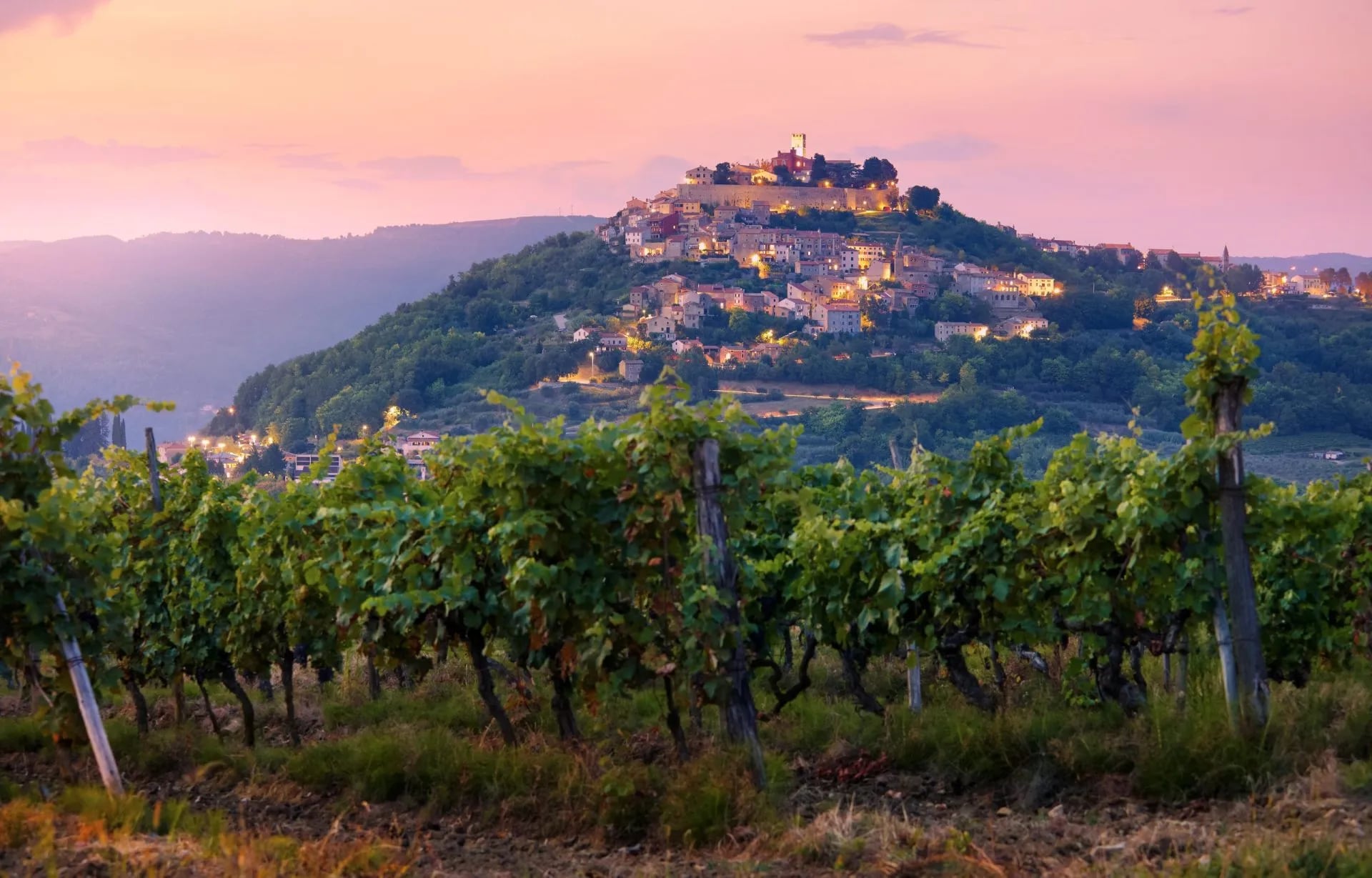
The gentlest walking in the country and the least Croatian-feeling: hilltowns, vineyards and truffle woods, closer to Tuscany than to Dalmatia. Motovun, Grožnjan and Hum each sit on their own hill, so the walking is a sequence of short climbs to a village rather than one long ascent. The old Parenzana railway threads between them on a graded bed, which is why a long day here need not be a hard one.
Days run long but nearly level, and it walks well from April, a month before the mountains open. Our Walk and Wine week covers it in stages of 10 to 24 kilometres. This is also the only part of Croatia where the food draws as much as the walking: truffles from the Motovun forest, Malvazija from the hills, and a konoba in every village.
Northern Dalmatia and Velebit
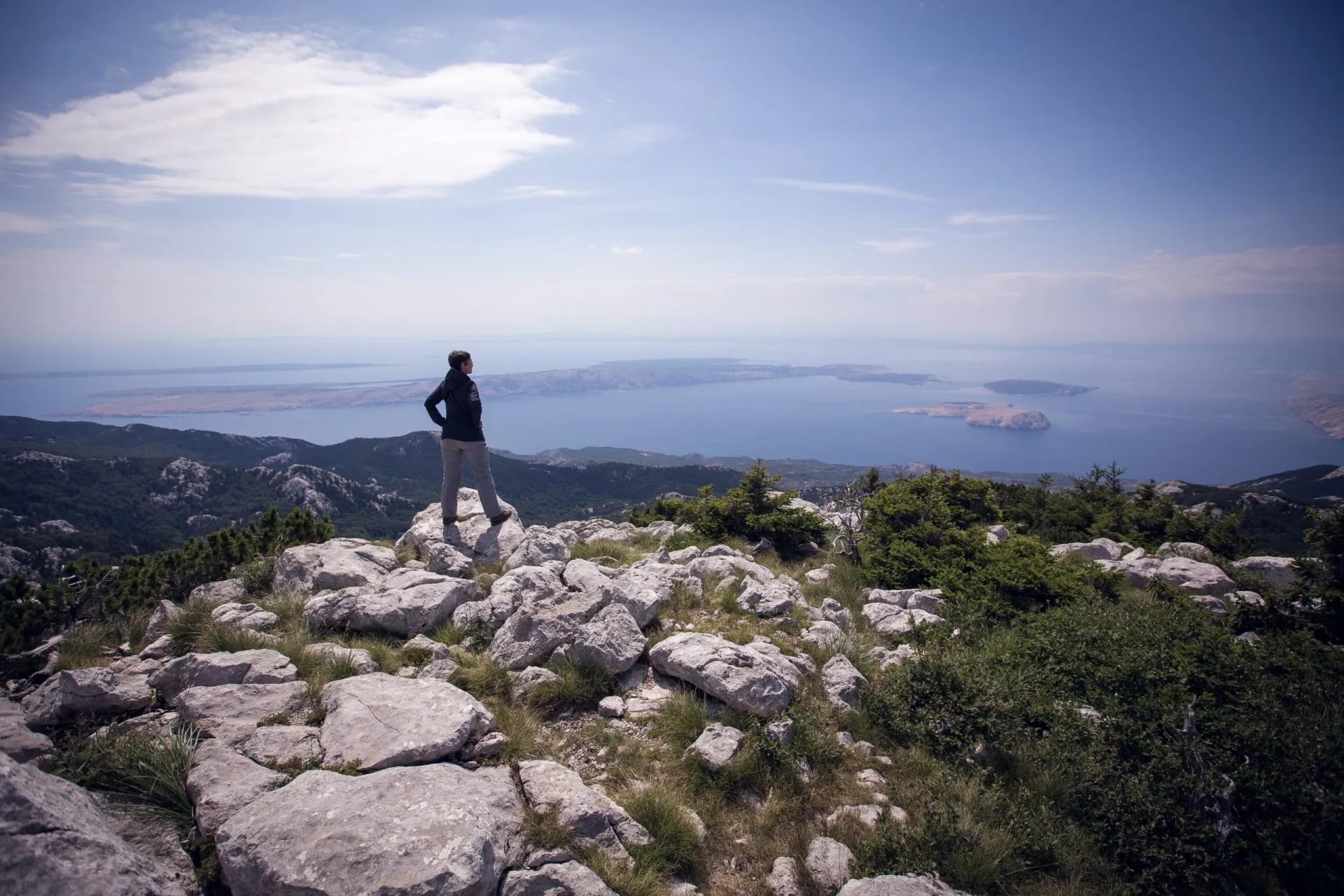
Where the walking turns serious. Velebit is the longest mountain in Croatia, a limestone wall above the sea for a hundred kilometres. The Premužić Trail traverses its finest section, and Paklenica cuts two canyons into its southern end. Nothing else in the country has this much ground above a thousand metres.
This is the only part of Croatia where you sleep in mountain huts rather than hotels, and the only part with real ascent, which is why our hut-to-hut week is the one trip here that feels like mountaineering. It also has the shortest season of any Croatian region, roughly May to September. On a weekday on the Premužić you can walk for hours and meet nobody.
The Dalmatian Islands
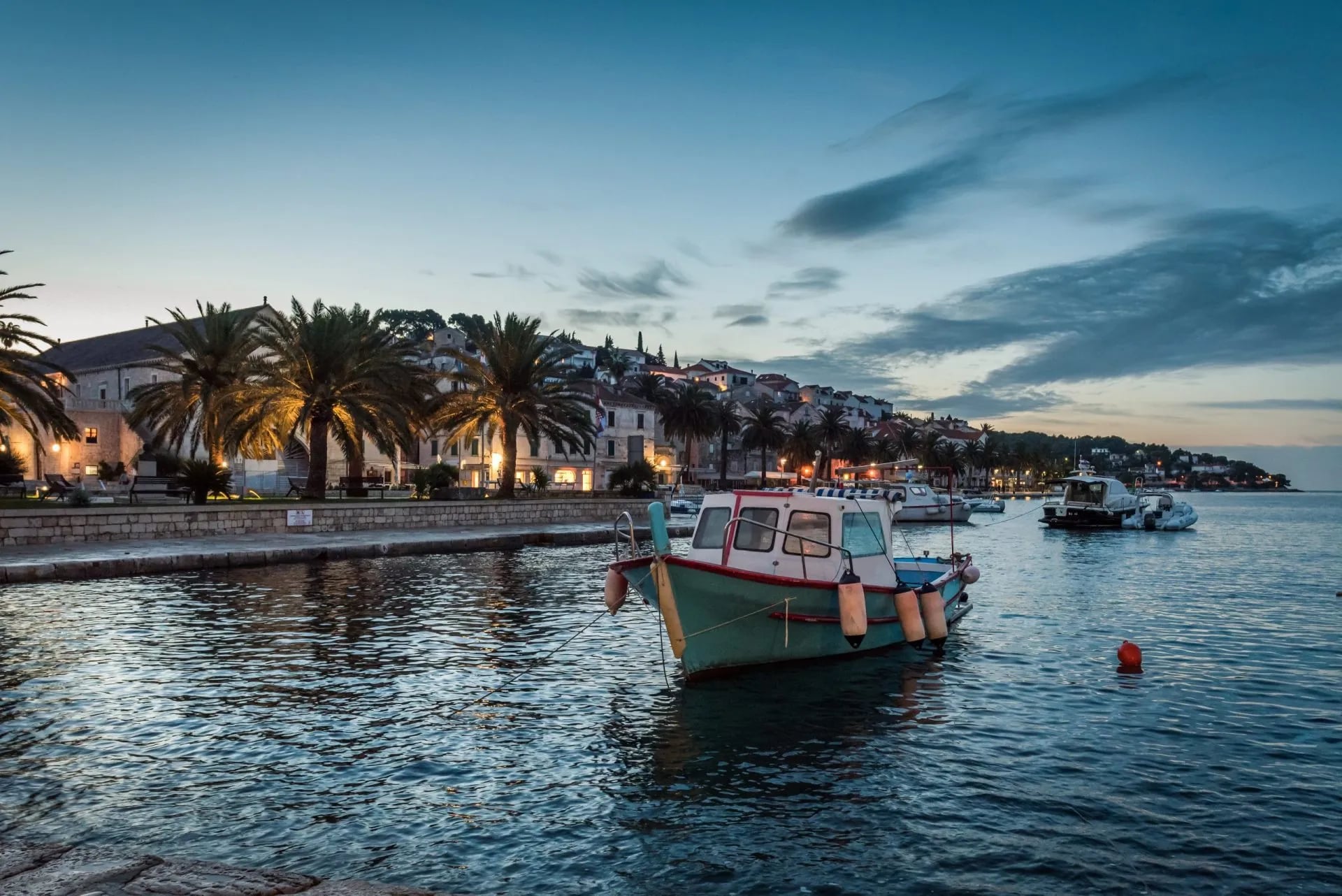
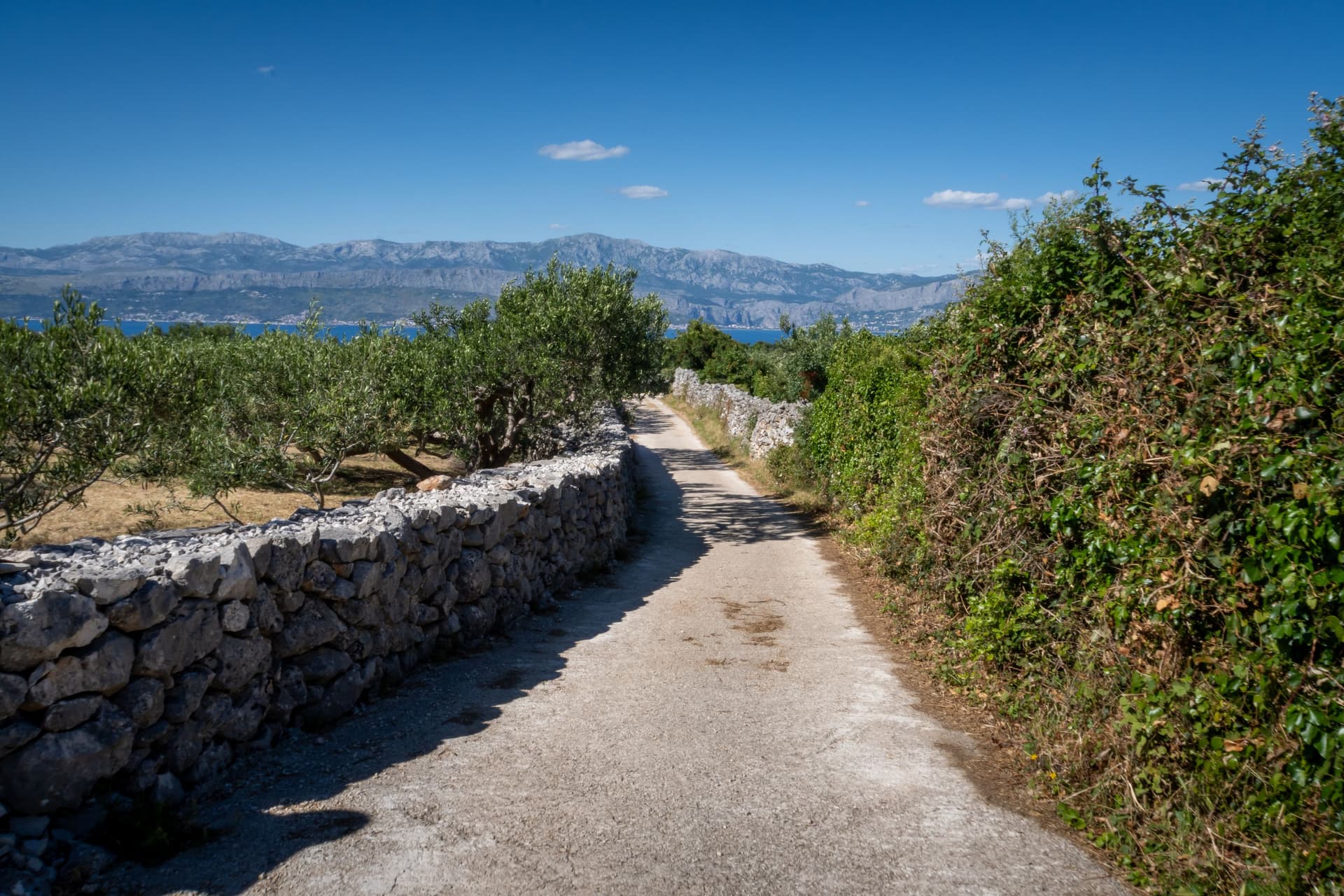
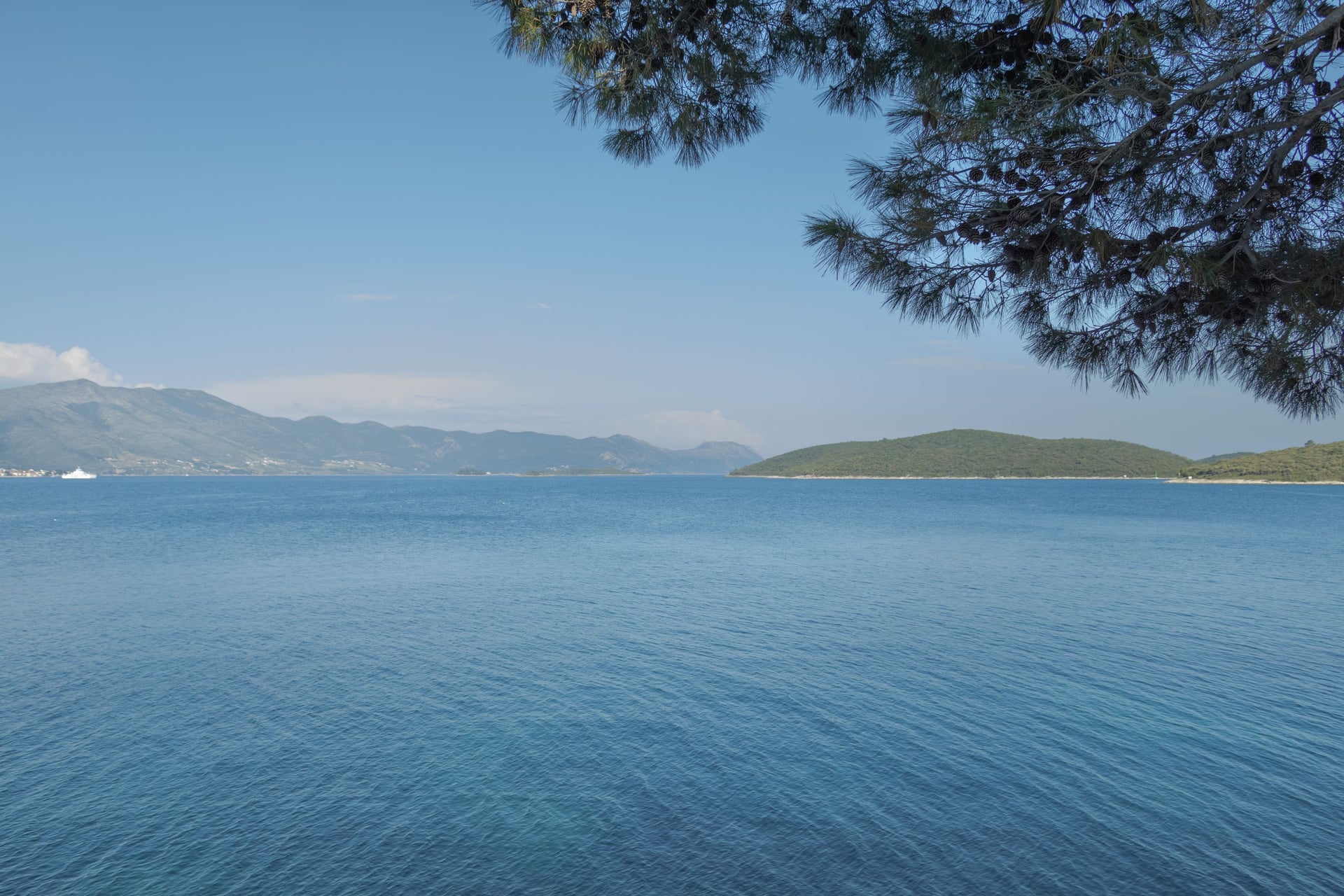
Hvar, Korčula, Brač, Mljet and Šipan, walked one after another with a ferry between each. Ascent is modest and the days are short, typically 6 to 13 kilometres, because the point is the sequence rather than the distance. No single island takes more than a day.
Expect stone paths through olive terraces, abandoned hilltop villages and a swim at the end of most days. The walking is never hard, but the sequencing is the skill: each island has one good crossing and no more. Our island-hopping week strings four of them together around the sailings, for 49.5 kilometres across the week.
Dubrovnik and the South
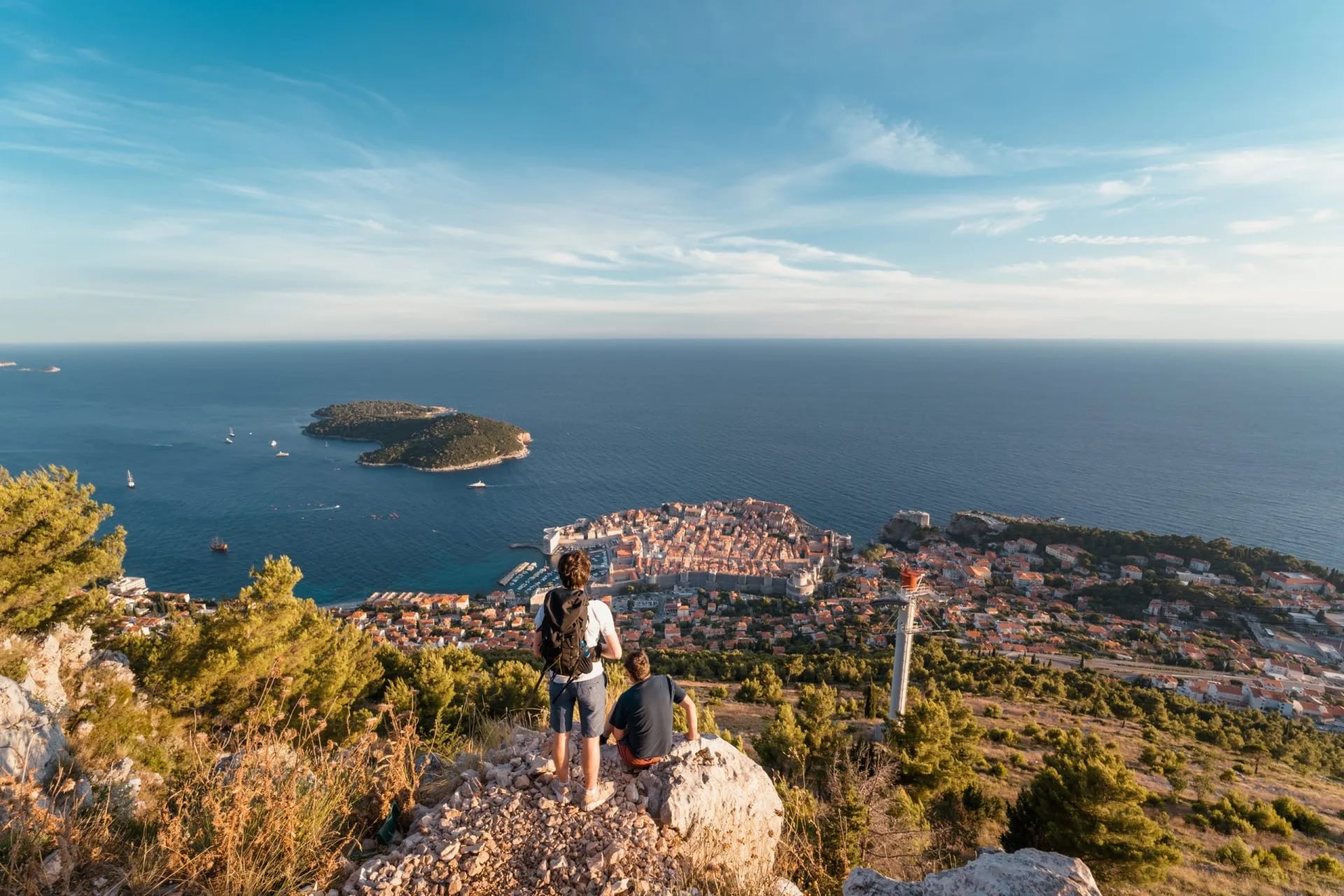
The softest walking of all, and the one to pick if the week has to suit mixed appetites. Our Dubrovnik and islands week totals under 30 kilometres across three walking days, on Mljet and on Šipan, the largest of the Elafiti islands. The other days are spent in Dubrovnik itself, which makes this the one Croatian week that works for a group of mixed fitness.
Šipan is a 10-kilometre day with 140 metres of climb, and the crossing between its two villages takes about four kilometres. Mljet gives 12 kilometres and 170 metres around the salt lakes. A shorter day then carries 320 metres up Montokuc, and nothing here climbs for longer than an hour at a time.
The Kvarner Coast and Učka
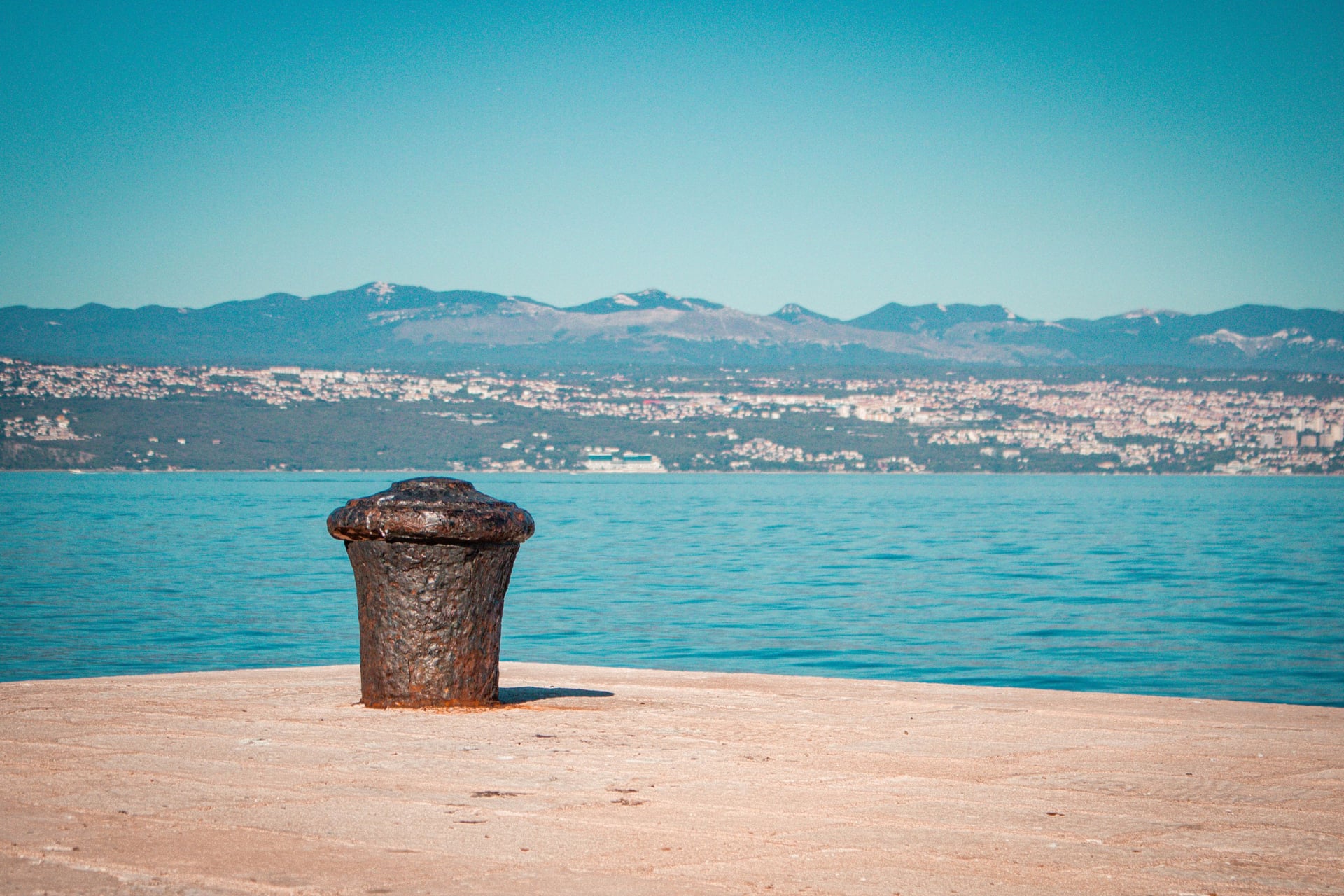
Above Opatija the Učka massif rises straight from the water, which is why a modest mountain feels bigger than it reads. Učka Nature Park covers 160 square kilometres and its summit, Vojak, stands at 1,401 metres. It is close enough to the sea that the whole Kvarner bay and the islands beyond it lie underneath the summit tower.
The walking day here is unlike any other in Croatia because it is almost all downhill. A transfer starts you at the Poklon pass at 922 metres, so the climb to Vojak is only 490; everything after the summit gives up height to Lovran at sea level. That is 1,410 metres of descent in 11.2 kilometres, the biggest drop on any of our Croatian weeks, and it is a day for knees rather than lungs.
The National Parks Worth Walking
Croatia has eight national parks. Four of them reward a walker, and the difference between them is bigger than the brochures suggest. The national parks service publishes trail information for each, and the Croatia walking trails worth a whole week are inside these four.
Paklenica National Park
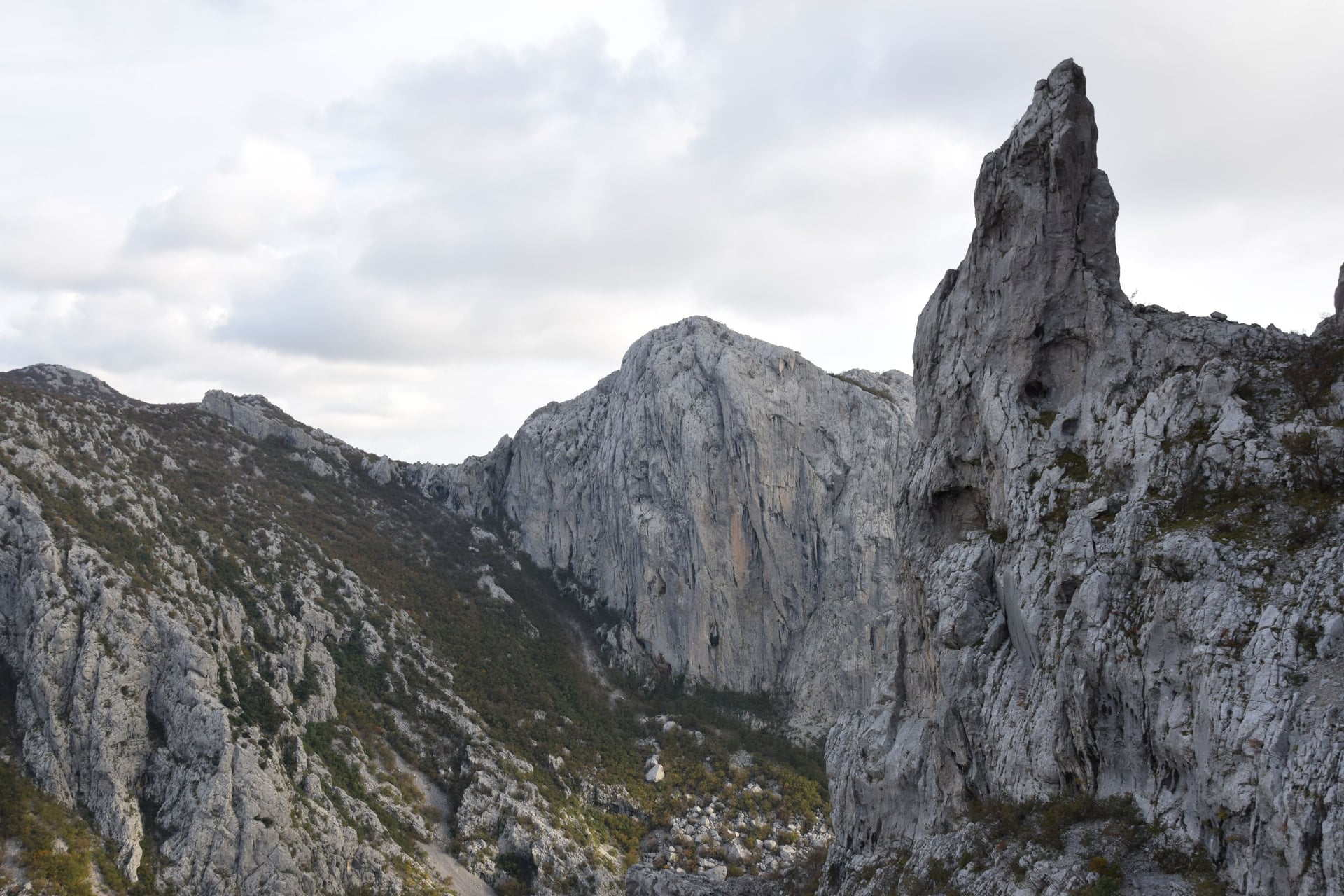
The walking park, and the only one of the four where a day will genuinely tire you. Two canyons, Velika and Mala Paklenica, cut back into the Velebit wall from a coast road that sits almost at sea level, so every route here starts by going up. The park holds Velebit's two highest summits, Vaganski vrh at 1,757 metres and Sveto brdo at 1,753, and it has been protected since 1949.
Its own trail network runs to between 150 and 200 kilometres, which is more than the other three parks combined. Walkers share the lower gorge with climbers, because Anića kuk is the biggest rock face in the country and carries routes up to 350 metres long; the Manita Peć cave sits partway up the same slope. Our national parks week takes it in 16 kilometres with 1,050 metres of ascent, the second hardest Croatian day on this page.
Plitvice Lakes National Park
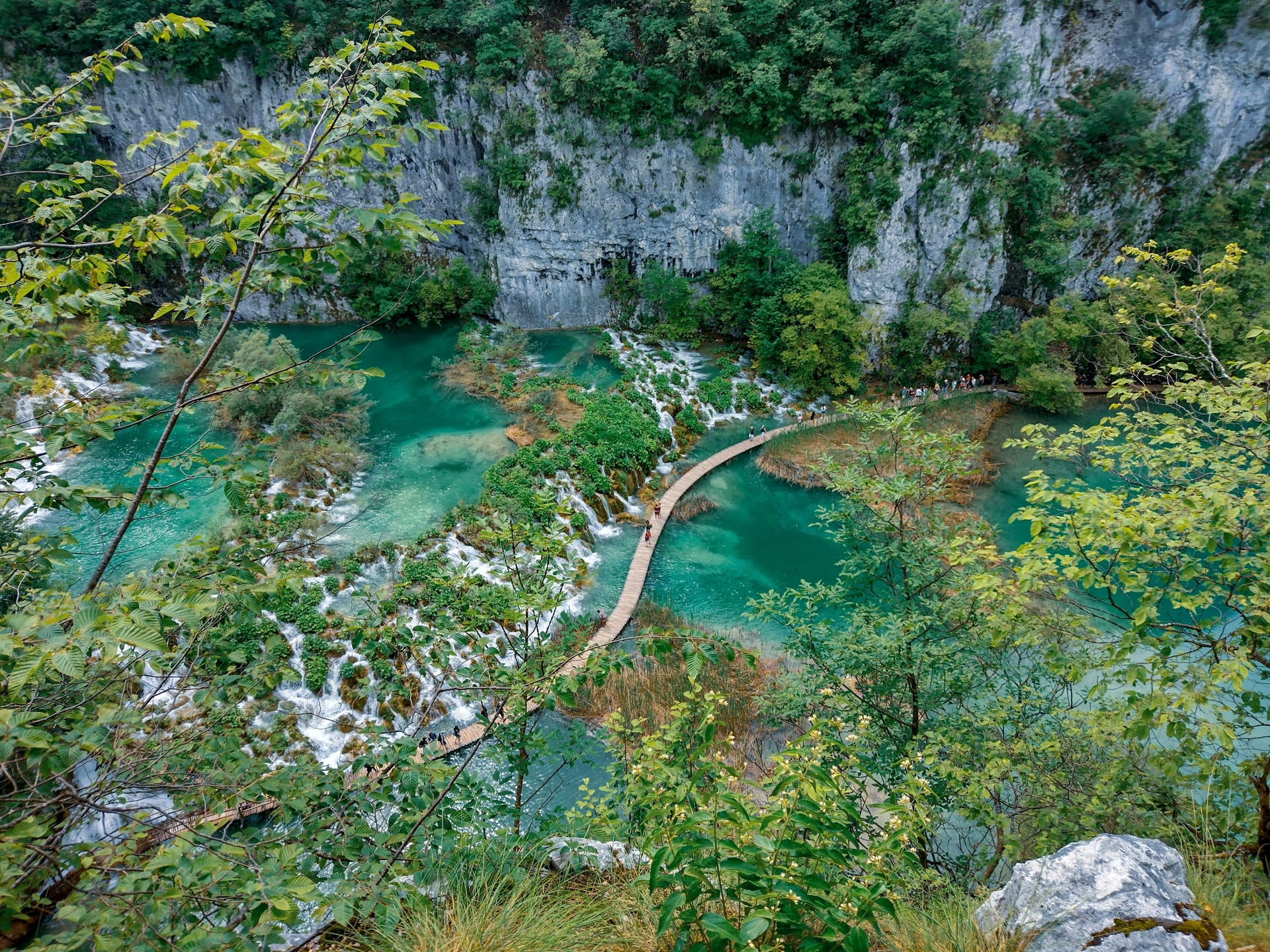
Sixteen terraced lakes joined by waterfalls, crossed on timber boardwalks barely a metre above the water. The park covers just under 300 square kilometres after its boundaries were widened in 1997, and it has been a UNESCO World Heritage Site since 1979. It is the most visited place in Croatia, which is the single fact that should shape how you plan a day here.
For a walker the honest description is level, crowded and ticketed. Our day is 8 kilometres with 140 metres of climb, and the boardwalks are one-way in high season, so pace is set by the people in front of you. Go at opening or in the last hours of the afternoon, and treat it as a sightseeing morning rather than a walking day.
Krka National Park
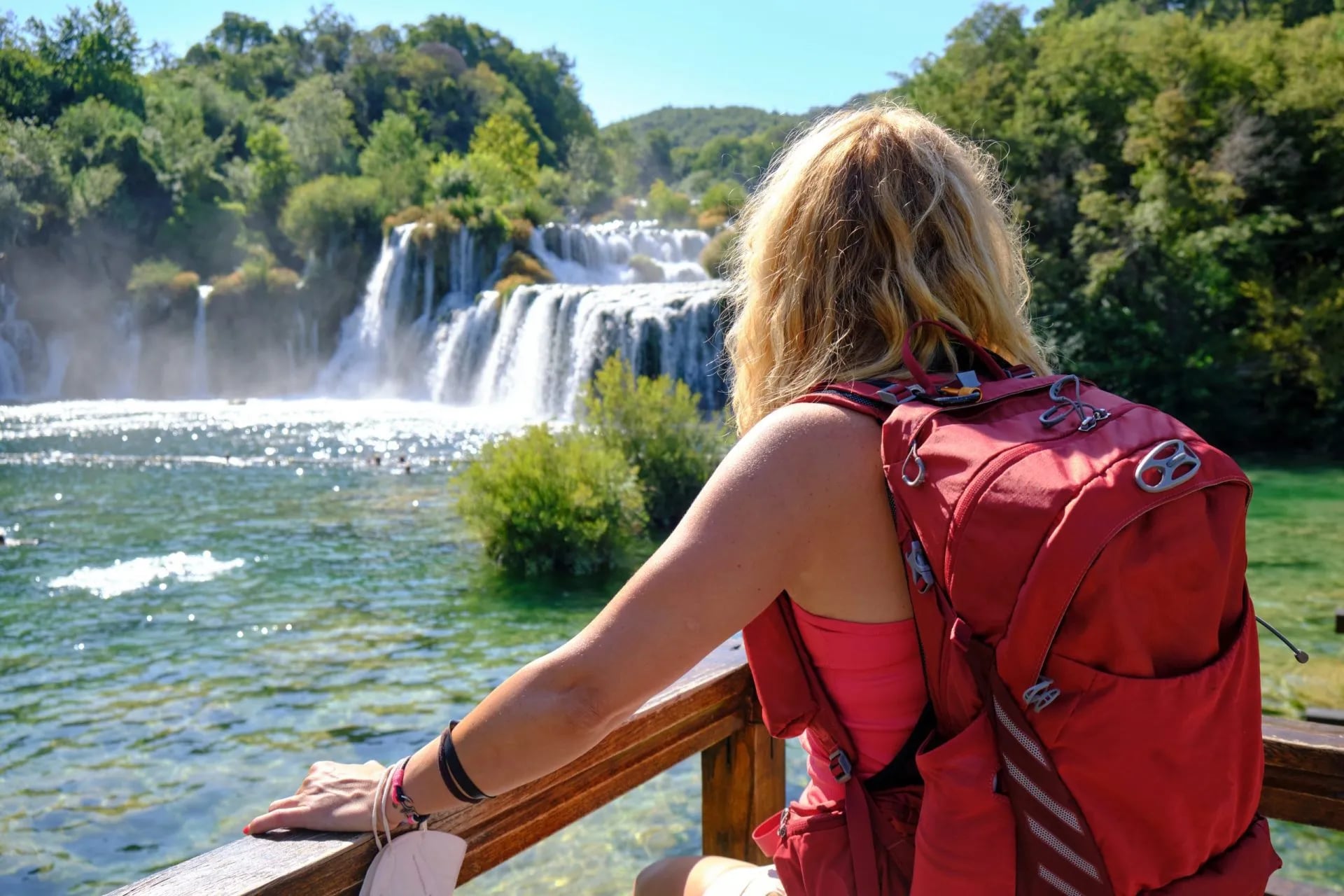
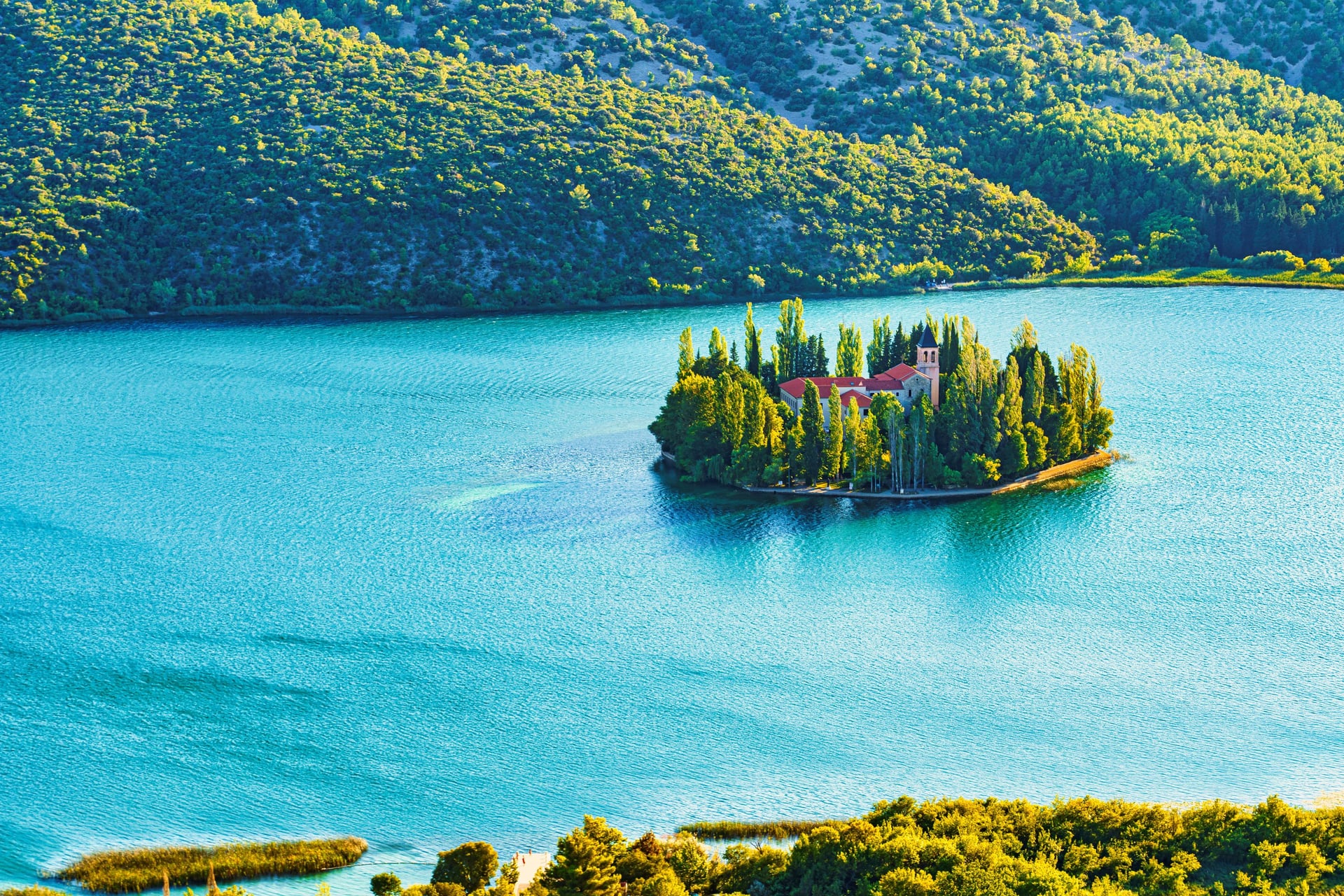
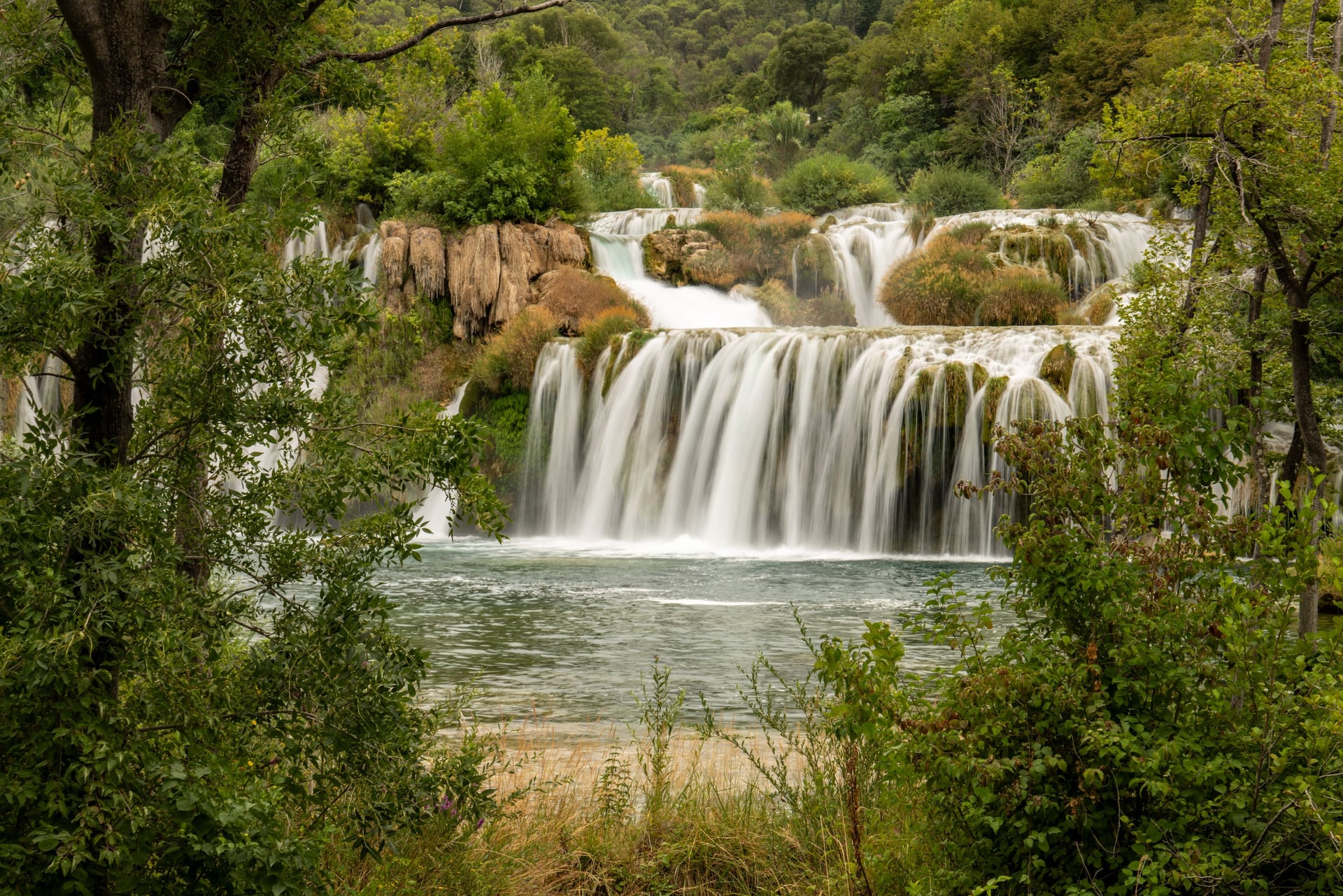
Kinder than Plitvice and less busy, and built around a river rather than a chain of lakes. The park covers 109 square kilometres and holds seven waterfalls along the Krka, of which Skradinski buk is the last and largest: seventeen steps spread over 800 metres of river, 200 to 400 metres wide, dropping 45.7 metres in total. Visovac, a monastery on its own island, sits upstream between there and Roški slap.
The walking is easy to underestimate in the other direction. Our stage is 10.8 kilometres and almost flat, which makes it a rest day inside a harder week rather than an objective of its own. Skradinski buk itself is boardwalk and steps and is busy by mid-morning, so the quieter walking is upstream, where the crowds thin within twenty minutes.
Mljet National Park
The park takes in almost 5,300 hectares at the western end of the island, roughly a third of Mljet, and the figure includes a belt of sea 500 metres out from the shore. Inside it are two connected salt lakes, Veliko and Malo jezero, ringed by Aleppo pine on what is the most forested island in the Adriatic. A twelfth-century Benedictine monastery stands on an islet in the larger lake, reached by the park's own boat.
It is the quietest of the four by a wide margin. Our day is 7.7 kilometres with 320 metres of climb up Montokuc, the highest viewpoint inside the park, and it is the only park day on any of our trips that ends with a swim. The lakes are warm enough for that from May, which is earlier than the sea on the mainland coast.
The Long-Distance Routes
Three named routes cross Croatia and only one is on our itineraries. The other two are worth knowing anyway.
The Parenzana
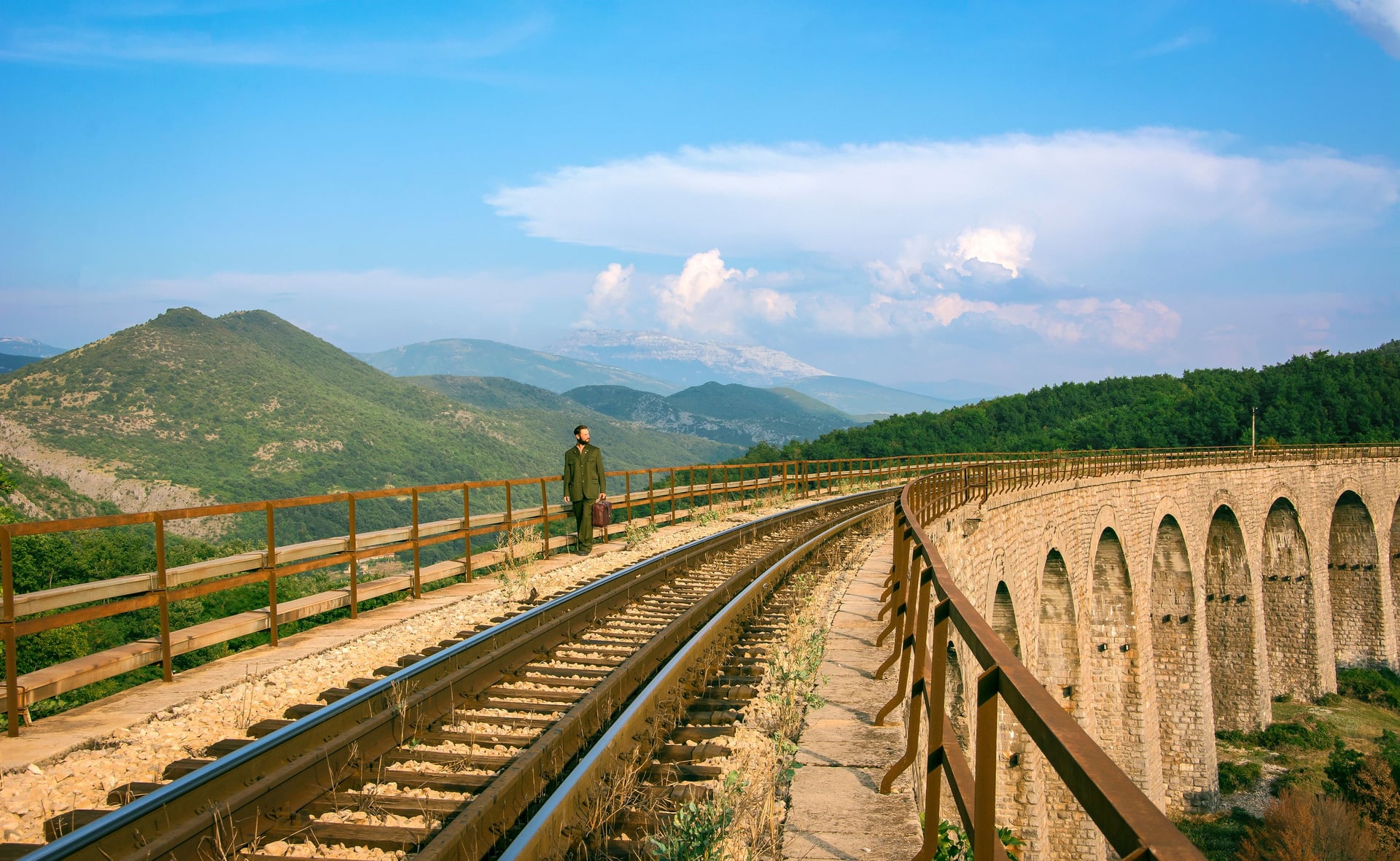
A dismantled railway, and the gentlest long walk in the country. The line ran 123 kilometres from Trieste to Poreč between 1902 and 1935, topping out at 293 metres near Grožnjan and dropping to two metres at the coast. It closed after 33 years of service, and the bed was left to the vineyards until it was reopened as a walking and cycling route.
The gradient never exceeds 2.8 per cent, so underfoot you barely notice you are climbing. Nine tunnels and six viaducts survive, the Freski viaduct among them at 68.5 metres long and 30 high. Our eleven-day version crosses three countries and never gains more than 310 metres in a day.
The Premužić Trail
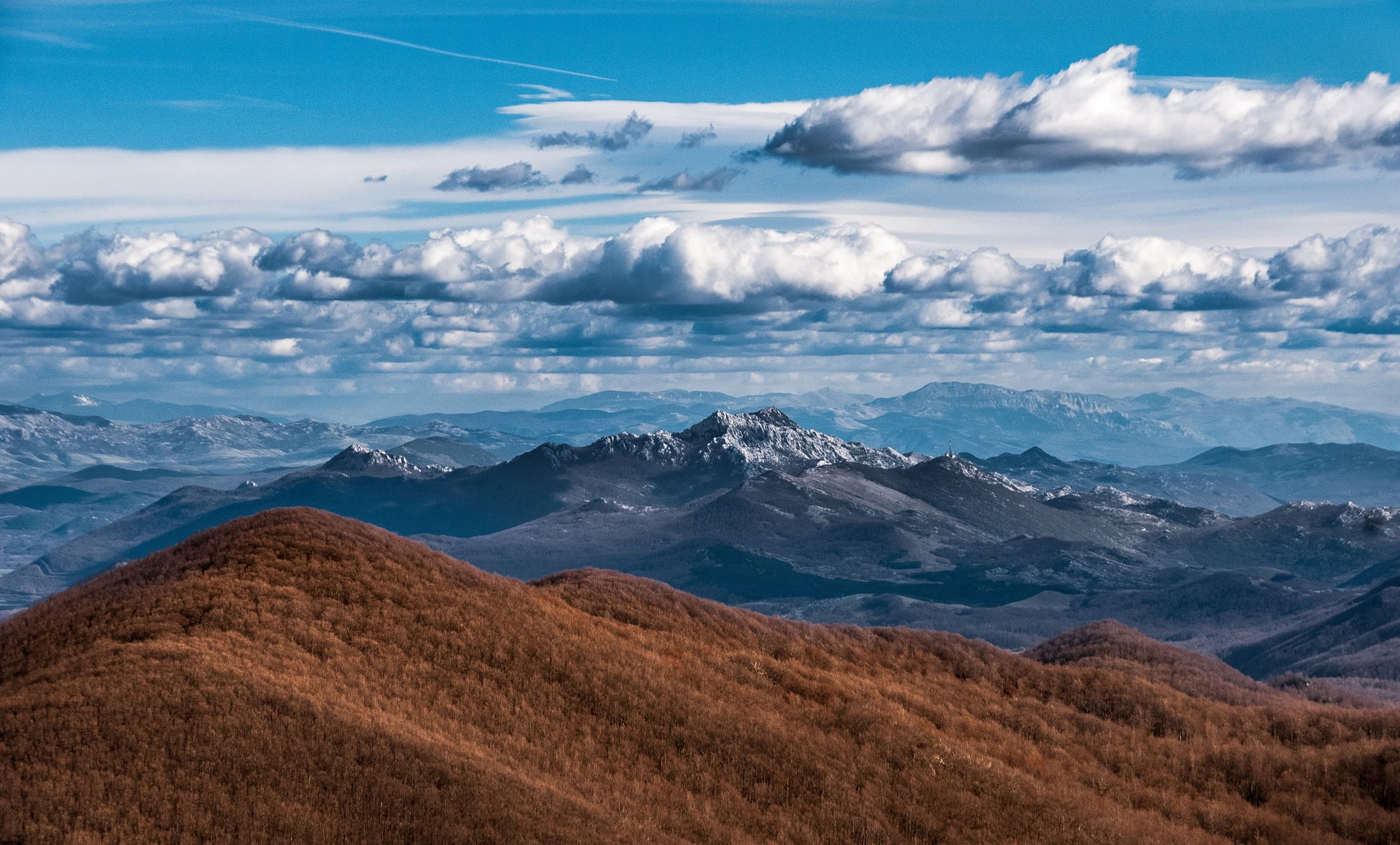
A hand-built stone path along the Velebit ridge, laid between 1930 and 1933. It is named after Ante Premužić, the forestry engineer who designed it. Zavižan to Baške Oštarije is about 50 kilometres, which is what our own three stages measure, though published figures run from 42 to 57 depending where they start counting.
Its reputation rests on one engineering decision. Premužić held a near-level line across limestone that looks impassable on a map, so the whole traverse goes in ordinary boots with no scrambling anywhere. The Adriatic and its islands sit below on one side, the Lika plateau on the other.
It is a descending traverse rather than a climb, which a profile does not show. Our first stage gains 410 metres and loses 650, the second gains 200 and loses 590. There is no shop and no village between the huts, so the food you start with is the food you have.
The Via Dinarica
The serious one, and the only route here measured in months rather than days. The White Trail runs roughly 1,260 kilometres along the high Dinaric range through Slovenia, Croatia, Bosnia, Montenegro and Albania. It is one of three parallel corridors, with a Blue Trail following the coast and a Green Trail the interior.
The Croatian section climbs the length of Velebit, overlapping the Premužić. It is a thru-hike rather than a holiday, and it is not on our itineraries. If that is the trip you want, the Premužić week is the honest way to sample it.
Our Croatia Walking Holidays
Six trips, ordered by hardest single day rather than total distance, because that is the number that decides whether a week is enjoyable. Every figure comes off the published itinerary.
Parenzana Railway Trek
Hardest day: 310 m of climb, Portorož to Buje
Length: 11 days, 9 of them walking
Total: 132.1 km, 1,150 m of ascent
The longest distance and the least climbing, which is the railway's doing. Stages run 7 to 25 kilometres with barely 300 metres of ascent on the worst of them. Choose it to walk every day and never suffer, and note that it starts in Italy and crosses Slovenia before reaching Croatia.
Dubrovnik and Croatia Islands Walking Holiday
Hardest day: 320 m of climb, on Mljet
Length: 7 days, 3 of them walking
Total: 29.7 km, 630 m of ascent
The gentlest of the six: three walking days, none over 12 kilometres, based on Šipan and Mljet. This is a holiday with walks in it rather than a walking holiday, and it suits anyone bringing a reluctant companion.
Best of Dalmatia Island Hopping
Hardest day: 340 m of climb, on Mljet
Length: 8 days, 5 of them walking
Total: 49.5 km, 1,010 m of ascent
Four islands in a week, with a ferry between each and days of 6 to 13 kilometres. The walking is easy; the logistics are what you are paying for, because doing this independently means building a week around boat timetables.
Hut to Hut Hiking Croatia
Hardest day: 410 m of climb, Zavižan to Alan
Length: 5 days, 3 of them walking
Total: 48.5 km, 780 m of ascent
Three long days along the Velebit ridge on the Premužić Trail, sleeping at Zavižan, Alan and Skorpovac. The ascent figures understate it: these are 14 to 19 kilometre days at altitude with no resupply, and the huts are dormitories rather than hotels.
Walk and Wine Istria Holiday
Hardest day: 490 m up and 1,410 m down, Poklon to Lovran
Length: 8 days, 6 of them walking
Total: 89.1 km, 1,800 m of ascent
Istria's hilltowns and vineyards for five days, then one very different stage off Učka. The 1,410 metre descent off Učka is the thing to prepare for. Long downhills punish knees in a way climbing does not, and poles help more than fitness.
Croatia National Parks Walking Holiday
Hardest day: 1,400 m of climb, Biokovo
Length: 7 days, 4 of them walking
Total: 48.1 km, 2,720 m of ascent
Read this one carefully. It covers the shortest distance of any week here and carries by far the most climbing: 2,720 metres over four walking days, with Biokovo at 1,400 metres and Paklenica at 1,050. Plitvice and Krka are the easy days between them.
When to Walk
The Croatian walking season is the opposite of the Croatian beach season.
April to early June: the best of it. Highs in the high teens to low twenties, wildflowers on Velebit, and the coast paths still empty
Late June to August: coastal highs sit around 30°C and the karst radiates it back. Too hot for anything with ascent
September to October: the second window, with the warmest sea of the year for a swim at the end of a walk
November to March: Istria and the coast stay walkable, but the mountain season has closed
Two dates matter more than the month. Our Velebit hut-to-hut week runs May to September, the narrowest window of any trip here, and the island catamarans thin out sharply from November.
Getting There, and Between Islands
Split and Dubrovnik take most flights, with Zadar the useful one for Velebit and Paklenica, and Pula or Trieste for Istria. Which airport you pick matters more here than in most countries, because the country is long and thin and the drive between its ends is most of a day. Nothing here needs a hire car on our trips, because transfers and ferries are arranged.
Independently, the ferries are what to plan around. Jadrolinija runs the car ferries and Krilo and TP Line the fast catamarans. Split to Supetar on Brač takes about 50 minutes on the car ferry and roughly half that on a fast craft, and Split to Hvar about an hour.
Fares are single-digit euros, so frequency is the constraint rather than cost. Outside summer a route with a dozen daily sailings drops to three or four, and a hard bura can cancel all of them at no notice. Croatia has been in Schengen since 2024, so there is no border queue arriving from the EU. Build a spare half-day into any independent island itinerary and the timetable stops being a risk.
Where You Sleep
Four genuinely different kinds of night appear on these trips, and the mountain ones are not what most people picture. The difference is worth understanding before booking, because it decides what you carry as much as where you sleep. On the Velebit week it changes twice inside three nights.
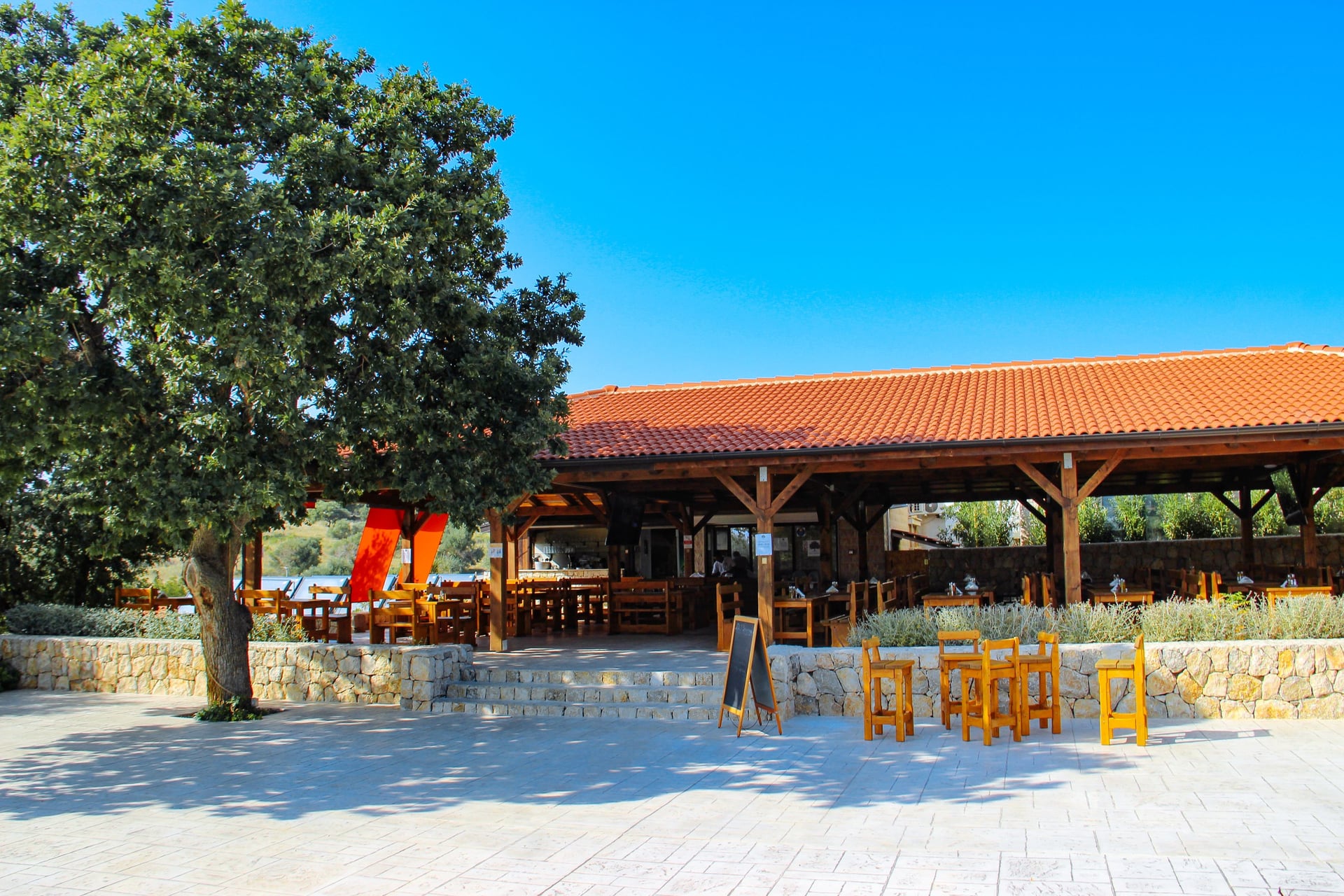
Hotels and family inns carry five of the six trips, with luggage moved on while you walk and breakfast included. Island konobas are a variant of the same thing: rooms above a family taverna, common on Šipan and Mljet. Neither asks anything of you beyond a day pack, which is why five of our six weeks suit walkers who have never used a hut.
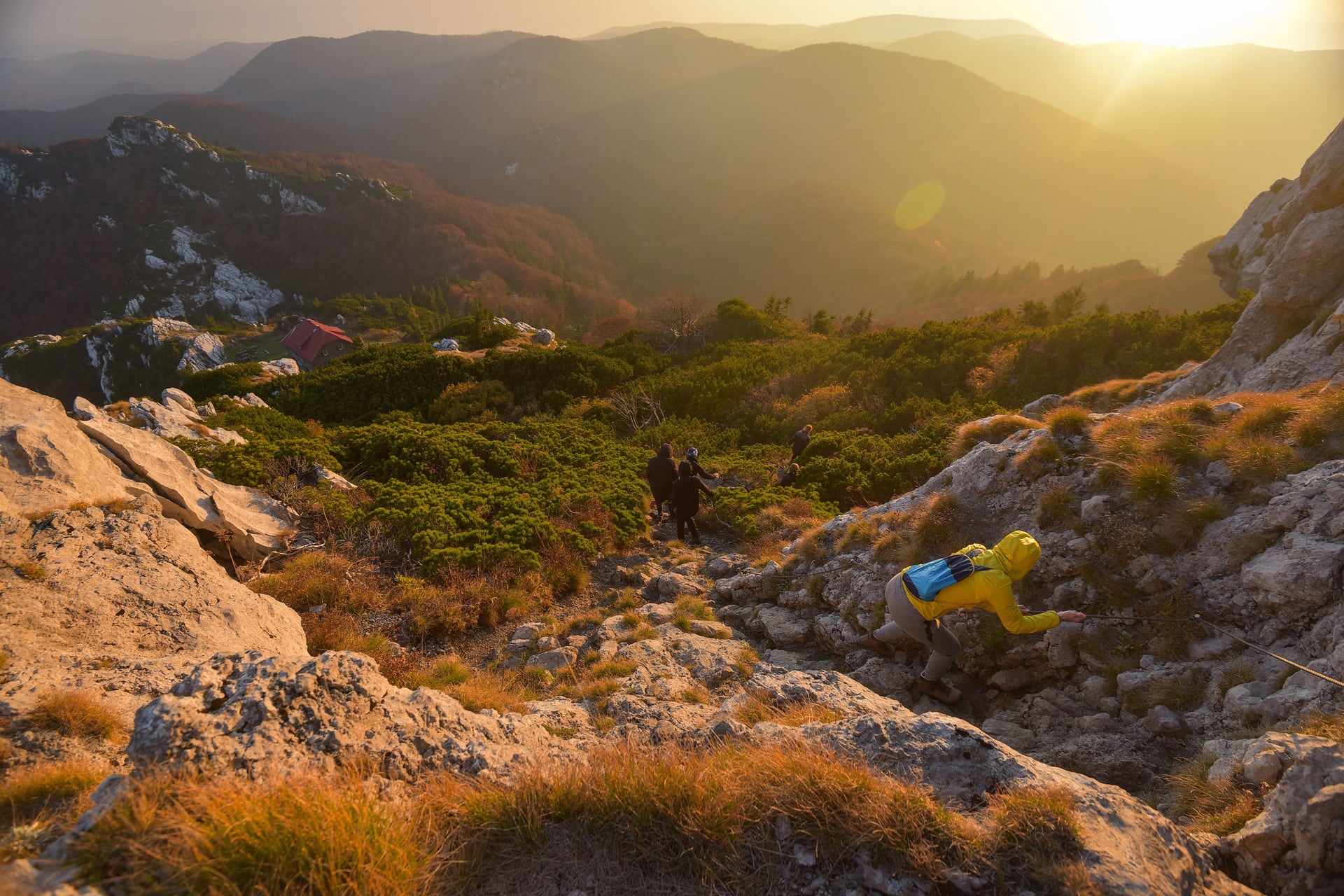
The Velebit week is the exception. The first mountain night is a staffed hut: Alan has beds or mattresses in shared rooms, one fixed dinner, and no shop. A warden is on site, so a sleeping bag liner is enough, and you eat what the kitchen has cooked.
The second is not a hut at all. Skorpovac is an unmanned refuge: no warden, no kitchen, and the choice of sleeping inside or pitching outside in the meadow, with your guide cooking. The week then ends in a village hostel at Baške Oštarije rather than up on the ridge.
Walking Velebit independently changes the sums. There are six shepherds' huts on Alan, of which three take guests and sleep 24 between them, the others being an info centre, a log cabin and a washblock with a shower. The park rents them whole rather than by the bed, in units sized for seven or ten, so a pair of walkers pays for the hut.
Three details decide whether that works for you. Bed linen costs extra at Alan and cannot be rented at all at Lubenovac, where a sleeping bag is compulsory. Between 1 July and 31 August neither set will take a one-night booking. And payment is on arrival or by bank transfer beforehand, not online at the last minute.
Know Before You Go
Six things catch people out, and none appears in a brochure photograph.
Park entry is banded by season, not fixed. Plitvice and Krka both charge least from November to March, more in April, May and October, and most from June to September. A winter adult ticket at Plitvice is a quarter of the June-to-September price, and at Krka nearer a sixth
The parks cost most when the walking is worst. The peak band runs June to September, which is exactly the stretch the karst is too hot for ascent. Walking in the good months is the cheaper option as well as the better one
Three ways round the peak rate: entering Plitvice after 4 p.m. in high season cuts it by well over a third, Krka discounts Croatian Hiking Society members in every band, and Krka's outlying sites (Roški slap, Manojlovac, Burnum) are priced below the full-park ticket. At North Velebit an annual pass costs about what seven single days do
There is no shade on the karst. Limestone reflects heat upward, and the Premužić has no shop or village between huts, so carry the day's water and start early
The bura is a real wind. A northeasterly off the Velebit arrives fast, stops ferries and makes ridges unpleasant
Mountain rescue is HGSS, reached on 112, and HGSS publishes its own mountain safety guidance. Velebit has patchy phone coverage
Frequently Asked Questions
Is Croatia good for walking?
Yes, for one specific reason: the range of terrain inside a small country. Searches for hiking in Croatia land on the same trips, and a single week can take in vineyards, a limestone canyon, four islands and a national park.
When is the best time for walking in Croatia?
April to June, or September to October. That is the opposite of the advice you will read for a beach holiday.
How difficult is walking in Croatia?
It depends on the trip: under 30 kilometres across a whole week on the Dubrovnik islands, against 2,720 metres of climbing on the national parks week.
Do I need a car?
No. Transfers and ferries are arranged on all six trips. Independently, check the Jadrolinija timetable before booking anything else.
Choosing Your Croatia Walking Holiday
Start with how much climbing you want, because that single number separates these six weeks more than the scenery does. The spread runs from 310 metres on the Parenzana's hardest day to 2,720 across the national parks week, a factor of nearly nine. Distance barely tracks it: the national parks week is the shortest of the six at 48.1 kilometres and by a wide margin the hardest.
Then pick the season, since the mountain trips run May to September while Istria and the islands add April and October at both ends. Read the ascent column before the photographs, because a coastal week at 20 metres a day and a Velebit week at 1,400 are the same holiday only on paper. Every figure on this page comes from the itineraries themselves, not from a brochure.
If you want a week shaped around a particular pace, talk to our team →


HASSLE-FREE
We handle itineraries, accommodations, and anything else you prefer not to deal with, so you can enjoy a carefree hike.

BOOK WITH CONFIDENCE
We are a financially protected company, fully bonded and insured, keeping your money safe and allowing you to travel with confidence.

TRIED & TESTED ADVENTURES
Only the best walking tours in Croatia, cherry-picked by our team with an in-depth knowledge of the region.

UNBEATABLE SUPPORT
Our 24/7 customer support is where we show our passion, bringing you a better experience by making your well-being our number one priority.